Mundhumism: Religion Dharma

Mundhumism: Beyond Religion and Dharma

Dr. Nawa Raj Subba

Brief Introduction

The present article provides a comparative analysis of the Kirat community’s original thought and way of life, ‘Mundhumism’, with the concepts of ‘religion’ and ‘dharma’ that are prevalent worldwide. Although Kirat Mundhumism is often viewed as an institutional religion or philosophical religion, its basic character is different and unique from both of these.

The main objective of the study is to substantiate on philosophical and practical grounds why Mundhumism is an ‘organic’ or natural way of life. In the course of the analysis, primitive ancestral concepts such as Yuma-Theba, prevalent in the Limbu community, and Sumnima-Paruhang of the Rai community are kept at the centre. Whereas Western ‘religion’ emphasises a certain divine text and institutional structure, and Eastern ‘religion’ explains cosmic laws and the cycle of karma, Mundhumism directly unites human existence with its ‘ancestry’ and ‘nature’.

This article presents three main arguments for considering Mundhumism as ‘organic’:

1. The relationship between soil and plants: Ingredients such as ginger, fenugreek, and bitter melon used in Kirat rituals show a deep connection to the biological cycles of nature.

2. The Hearth Philosophy: Considering the three-stone hearth of the home as the centre makes it clear that this philosophy is based on the basic needs of human life and family continuity.

3. Ancestor-Nature Axis: In this philosophy, God is not some distant supernatural force but one’s own primitive ancestors and the surrounding environment (forests, rivers, mountains).

In conclusion, Mundhumism is not an imported or manufactured idea but a vibrant ‘organic’ path that has spontaneously evolved along with the historical development of Kirati civilisation. It provides the modern world with an original vision of living in balance with nature and taking pride in its historical identity.
More on Zenodo

More on Figshare

Publications

Similar Posts

  • Practices of waste management in health care facilities in Nepal’s Biratnagar metropolitan city.

    Nawa Raj SubbaWorld Journal of Advanced Research and Reviews, 2021, 12(03), 398–404 Abstract Biratnagar is a medical referral centre with tertiary health care in Eastern Nepal. The city population is 202,061, according to the 2011 census. There are 35 Health Care Facilities (HCFs) in the city as of 2014. There are 7 HCFs, 2 nongovernmental…

  • वंशावली-२०८१

    डा. नवराज सुब्बा वंशावली-२०८१: हाम्रो इतिहास र पहिचानको दस्तावेज वंशावली भनेको केवल नामहरूको सूची होइन, यो हाम्रो जरा र इतिहासको ऐतिहासिक दस्तावेज हो। वंशावली-२०८१ ले हाम्रो परिवार र समुदायलाई केवल जोड्ने मात्र होइन, हाम्रो जातीय इतिहास र पहिचानलाई राष्ट्रिय परिप्रेक्ष्यमा प्रस्तुत गर्ने महत्त्वपूर्ण माध्यम बनेको छ। यस लेखमा, वंशावली-२०८१ कसरी तयार भयो, यसले हाम्रो इतिहासलाई…

  • शिव सीमाभन्दा पर

    — डा. नवराज सुब्बा शिव सीमाभन्दा पर… लेख्नुपरेको कारण शिव सीमाभन्दा पर: प्रोटो-शैववादको विश्वव्यापी यात्रा — दार्शनिक, प्रतीकात्मक, र सांस्कृतिक तुलनात्मक अनुसन्धान आजको विश्वमा धार्मिक तथा सांस्कृतिक बहसहरू प्रायः क्षेत्रीय दृष्टिकोणमा केन्द्रित भइरहेका छन्। तर मेरा लागि सधैं एउटा प्रश्न उठिरहन्थ्यो—“के कुनै पनि धार्मिक अवधारणा केवल एउटै भूगोल र सभ्यताको उत्पादन हो?” यही प्रश्नको मूलबाटो…

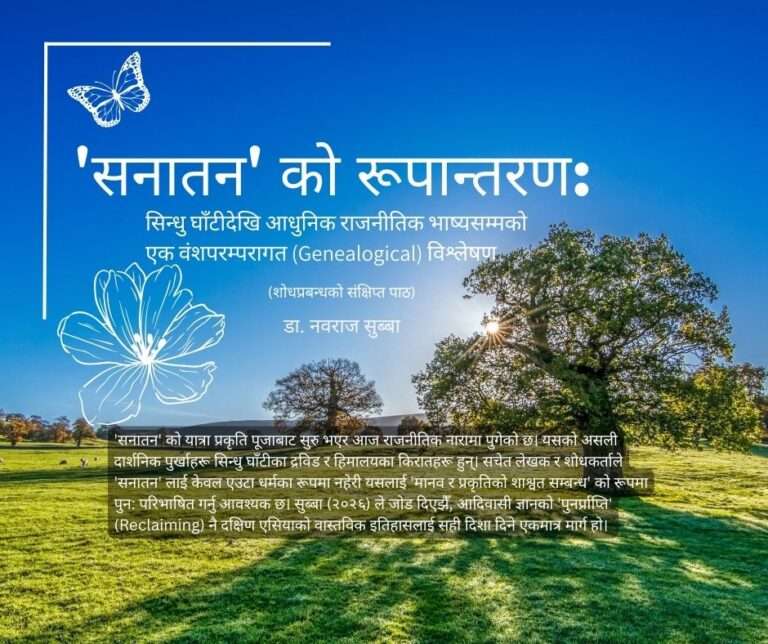
  • ‘सनातन’ को रूपान्तरण

    ‘सनातन’ को रूपान्तरण: सिन्धु घाँटीदेखि आधुनिक राजनीतिक भाष्यसम्मको एक वंशपरम्परागत (Genealogical) विश्लेषण (शोधप्रबन्धको  संक्षिप्त पाठ) लेखक: डा. नवराज सुब्बा १. सार  प्रस्तुत शोधपत्रले ‘सनातन’ शब्दको ऐतिहासिक विकासक्रम र यसको दार्शनिक रूपान्तरणलाई आलोचनात्मक ढङ्गले विश्लेषण गर्दछ। प्राचीन सिन्धु घाँटीको सभ्यतामा प्रकृति-केन्द्रित ‘शाश्वत नियम’ का रूपमा रहेको यो अवधारणा कसरी कालान्तरमा धार्मिक पहिचान र राजनीतिक औजारमा परिणत…

  • Traditional and Modern Maternal and Child Health Care Practices and its Effects on Rajbanshi Community in Nepal

    To cite the article: Nawa Raj Subba. (2015). Traditional and Modern Maternal and Child Health Care Practices and its Effects on Rajbanshi Community in Nepal. Journal of Public Health in Developing Countries, 2015 Ph.D. Thesis Abstract. Abstract Background: Rajbanshi is one of the indigenous and underprivileged communities in Nepal. The present research is a descriptive and…