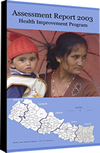
Assessment Report 2003 Health Improvement Program Nepal

Report on Assessment of Health Improvement Program in Eastern Nepal 2003
Survey Conducted by Eastern Regional Health Directorate Dhankuta and Britain Nepal Medical Trust.

The study to assess the health and health care delivery status in Eastern Development Region of Nepal was carried out by the Health Improvement Program of The Britain Nepal Medical Trust (BNMT) in close collaboration and coordination with Eastern Regional Health Directorate. This study is expected to provide insights into the current status of health; gaps in availability, accessibility and utilization of health care services; current and potential aspects that affect health and thus to guide health managers and partners to identify appropriate interventions to improve health status in the Eastern Development Region of Nepal through strengthening the capacity of local communities.
This report includes the key findings of the assessment. It is a summary for dissemination to the central level partners. At this moment, we would like to thank all members of central, regional, district and community level assessment teams for their contribution in the entire process of assessment. We would also like to thank officials from AC Nielsen Private Limited and the Eastern Regional Health Directorate for their immense and continued support and encouragement. We are also thankful to all the field staff of BNMT for their hard work during the assessment.


English Version Preview/Download
Similar Posts

  • Genealogy-2024

    The Genealogy of Phyang Samba 2024 What’s in a Genealogy? A Deep Dive into the Ancestry of the Phyang Samba Clan Genealogy is much more than a family record—it’s a bridge connecting the past, present, and future. In Kirat Rai and Limbu communities, significant life events such as birth, marriage, and death are marked with…

  • |

    Shaivism: A Spiritual and Historical Exploration of Its Origins and Evolution

    Dr. Nawa Raj Subba Mythology and Cosmology in the Shaivism Belief System Shaivism is about much more than faith and ceremony; it is a perspective on the dynamic nature of universal energy, one of self-realization, and deep spirituality. In Shaiva, Shiva is “Satchidananda” (Sat-Chit-Ananda) — existence, consciousness, bliss. This research investigates the intellectual and symbolic aspects of Shaivism…

  • | |

    मनको-मझेरी

    नवराज सुब्बाका निबन्धहरू: मनको मझेरी नवराज सुब्बाद्वारा लिखित “मनको मझेरी” निबन्धसंग्रह २०६४ सालमा वाणी प्रकाशन, विराटनगरद्वारा प्रकाशित एक चर्चित कृति हो। यो संग्रहमा २० वटा निबन्ध समावेश छन्, जसले सामाजिक, सांस्कृतिक, साहित्यिक र व्यक्तिगत अनुभूतिहरूलाई गहिरो रूपमा उजागर गर्छ। “मनको मझेरी” निबन्धसंग्रह २०६४ संग्रहका विशेष निबन्धहरू: नयाँ नेपालको चित्र तस्वीरमा पोखिएका कविताहरू श्रद्धाञ्जलि एउटी लिम्बूनीलाई…

  • |

    आकाश आत्मा बीचको संवाद

    📘 डा. नवराज सुब्बाद्वारा लिखित आध्यात्मिक खण्डकाव्य आकाश र आत्मा बीचको संवाद खण्डकाव्यमा आत्मा आकाशसँग बोल्छ— मौनता, प्रतीक र प्रकृतिको लयमा। आकाश ब्रह्माण्डको प्रतिनिधित्व गर्छ भने आत्मा चेतनाको गहिरो स्तर हो। यी दुईबीचको अन्तर्दृष्टिपूर्ण संवादले पाठकलाई स्व-अन्वेषण, साँस्कृतिक स्मृति, र आध्यात्मिक पुनर्जागरणतर्फ डोर्याउँछ। खण्डकाव्यको संरचना र मौलिकता काव्यको संरचना विभिन्न सर्गहरूमा विभाजित गरिएको छ, जहाँ…

  • | |

    जनस्वास्थ्यका-सवालहरू

    जनस्वास्थ्यका-सवालहरू: जनचेतना र स्वास्थ्य प्रबर्धनका लागि मार्गदर्शक पुस्तक विधा: लेखलेखक: नवराज सुब्बासंस्करण प्रथम: २०६४पुस्तकमा संग्रहित लेखहरू: ४९ परिचय जनस्वास्थ्यका-सवालहरू नवराज सुब्बाद्वारा लिखित, जनस्वास्थ्य र जनचेतना सम्बन्धी ४९ लेखहरूको संग्रह हो। यो पुस्तक जनस्वास्थ्यका विविध पक्ष, स्वास्थ्य समस्याहरू, तिनका समाधान, र स्वास्थ्य नीति तथा कार्यक्रमहरूको बारेमा गहन जानकारी दिन्छ। यसले साधारण पुस्तकका मुख्य विषयवस्तुहरू यस पुस्तकमा…

  • | |

    Traditional & Modern Cares in Rajbanshi

    This is a descriptive and cross-sectional study on Rajbanshi of Nepal undertaken in 2010. The common theories in Ethnographic/ Indigenous Psychological perspective, Social Construction theories, and Public Health perspectives have navigated the study. This study poses both qualitative and quantitative methods: interviews, observations, and examinations. Household samples were randomly taken and clusters taken by purposive…

Leave a Reply