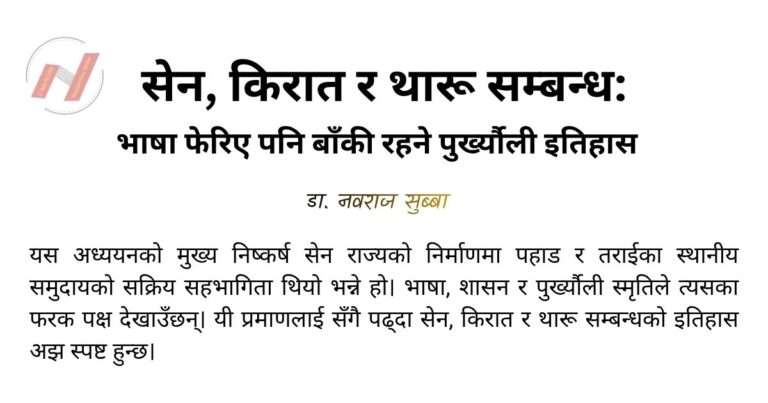
Sen, Kirat, and Tharu Relationship
The Sen, Kirat, and Tharu Relationship: An ancestral history that remains even as languages change
Nawa Raj Subba, Ph.D.
Summary
This article provides a comparative overview of the Syamohara of the Sena period and the research on the origin of Tharu, Kirat Mundhum and Limbu genealogies. The purpose of the research is to understand the genesis and geographical expansion of Sen, the connection with the Kirat leadership and the historic value of the presence of the Tharu language. The study has been based on available documents, published research, and ancestral memory.
Historically there is an opinion that associates Tharu with Kirat. There is also one study that indicates that the words which can be of Tibeto-Burman origin are still preserved in the family’s Tharu language. It proves that the community does not have an ancient origin as determined by the present day language. As well as the growth of the Hindu culture, marriage, migration, trade and governance can have contributed to changes in language.
The lineage claims of the Sen vary from each other. The Kirat rulers, however, seem to have had some significant influence on the expanding eastern kingdom. The hereditary Chautariya position, the right to sign orders, and military participation reinforce this. In Syamohar, the linguistic form, which is similar to the Tharu, shows a connection between the authority of the hills and the writing practices of the Terai.
The genealogical records of Tungdunge Mundhum and Sen Chabegu, Yonghang and Lingden provide a basis for tracing the ancestral relationship between the Sen and the Limbu. These traditions indicate that some families or branches related to the Sen may have been incorporated or merged into the Limbu lineage through marriage, settlement and social acceptance. Whether such a merger also occurred with the Rai lineage must be examined separately from the related genealogical traditions and records.
Merger in lineage does not mean the erasure of old ancestral ties. It also means that a branch adopts a new community identity while preserving the memory of old kinship. However, these materials do not establish a single origin for all Sen, Tharu, Rai, and Limbu.
The study concludes that local communities actively participated in the creation and continuation of the Sen state. Sen history can only be appreciated within a context of its dynastic roots, language, authority, marriage, hereditary inclusion, and social acceptance. This offers guidance in the path to finding a common past.
Keywords: Sen dynasty, Kirat, Tharu, Limbu, Rai, Syamohara, Mundhum, language change.
1. Introduction
People can change their language. However, their ancestors do not. Religion and social identity may also change. But some parts of the old way of life remain. They can be found in speech, customs, place names, and ancestral stories.
This is important to understand the history of the Tharu. Today, the Tharu languages belong to the Indo-European family. This explains their current linguistic form. This does not mean that all the ancestors of the Tharu always spoke this language.
The same question arises in the study of Sen and Kirat relations. The linguistic form of the Terai is found in the Sen period’s Syamohar. The memory of the Sen relations is found in the Limbu Mundhum and Vamsavali. When these sources are taken separately, only a part of the relationship is seen. When read together, the long history of the local society can be traced.
This is the main idea of this article. The language of the Sen period is evidence of the regime of the time. Exploring the social history of that language also opens up the question of ancient ancestral relations.
2. What studies are available on the Tharu-Kirat relationship?
The Kirat origin of the Tharu is mentioned separately in the review article of Nathuram Chaudhary of 2026. It says that Rahul Sankrityayan believes that the Tharu are a subset of Kirat. The Tharu and Dongba are also related to the Thangdao as per the genealogy of the Kirat community (Chemjong, 2003 as cited by Chaudhary 2026: 67).
Later, according to the same article, the Tharus who believed in nature and earth were converted to Hindu culture. This is another testament to the fact that there is a written tradition on Kirat relationship of the Tharus and religious change. This is not just a baseless assumption made now.
But the article is a review of old opinions. It does not establish the lineage of all Tharus by giving the original text of a single Mundhum. Therefore, the concrete conclusion drawn from it is this: The historical opinion linking Tharus to Kirat is strong. It also has a basis for comparing it with linguistic and cultural evidence.
Here, the meaning of ‘Kirat’ should be clarified. In ancient writings, it could refer to a broad group of people. It should not be confused with today’s Rai or Limbu identity. Tharu may be related to the ancient Kirat tradition. But this does not mean that the Tharu race is derived from the present-day Rai or Limbu.
3. Part of the old language in the Tharu dialect
Chaubey and colleagues’ study has provided important linguistic details. They have noted that in some Tharu communities, the language spoken outside and inside the home is different. It is noted that words from outside the Indian dialect remain in the home dialect. They suggest that some of them may be of Tibeto-Burman origin (Chaubey et al., 2014).
This description gives a new direction to the research. The current linguistic form of Tharu may contain parts of the old language. Therefore, the entire linguistic history of the community cannot be written by looking only at the external speech.
How did such words survive? Did they survive by abandoning the old language and adopting a new one, or did they come from a neighboring language? Comparison is needed to distinguish this. Household words, names of relatives, body parts, and cultural terms are particularly useful.
On this basis, it is reasonable to search for the ancient linguistic relationship of Tharu. This cannot be dismissed as mere speculation. But it is also not possible to immediately decide which ancient language was definitely from the few remaining words.
4. Hindu contact and the process of language change
Adopting Hindu culture and speaking an Indian language may be related processes. But the two do not always go hand in hand. The influence of religion may be one factor. Migration, marriage, trade, and governance can also change language use.
The study of language contact emphasises such social situations. A community may initially speak two languages. Later, the new language may spread into public life. In the next generation, it may also take hold in the home. Some parts of the old language may remain (Thomason, 2001).
The Tharu community may have adopted the Indian language over time instead of the old language. As the language changed, some words from the old language may have remained in the dialect.
Some ancestors of the Tharu community may have abandoned the old language and adopted the Indian language. In the process, some parts of the old words and speech patterns may have remained.
This is an explanation of the process of language change. Religious conversion is a possible background to it. But the sources found do not establish the claim that Hindu contact was the sole cause.
This difference does not weaken the original hypothesis. Rather, it clarifies the path of inquiry. Now religion, social power, and the domestic use of language can be viewed together.
5. What genealogical studies add
Chaubey and colleagues have found South Asian and East Asian ancestry in the Tharu group studied. The amount varies by group. This suggests that the Tharu people’s history is multi-sourced (Chaubey et al., 2014).
This does not mean that the East Asian part is the ‘Kirat lineage’. The study did not identify that. It also did not examine the lineage relationship with the Sen.
But its importance is clear. The ancestral history of the Bharopeli-speaking community today is not limited to that linguistic family. Therefore, it cannot be said that the ancient Kirat connection is impossible by showing the current classification of the language.
At the same time there is diversity among the Tharu as well. Guneratne’s study, however, demonstrates a common Tharu identity which developed despite the presence of groups with different local histories and cultures (Guneratne, 2002). It should therefore not be taken as a fact that all Tharu people left the same old language at the same time.
6. How to read the Sena period Syamohara on this basis?
In the text published in Syamohar in 1743 AD, it is mentioned that “Jas Raike Change Gaam Dihal”. In the text published in 1754 AD, Mahipati Senko Moharma, “Jagdeep Raike Tavor Phat Suchi Rajaka Shayan Dihal…” is mentioned (Gorkhapatra Online, 2082).
Forms like ‘basahu’, ‘basaavahu’, ‘jotahu’ and ‘jotaavahu’ are found in other Sen period documents (Nepal, 2074). These forms provide a basis for comparison with the linguistic world of eastern Terai.
In Saptari Tharu, ‘ke’ functions as a relation and recipient. Forms like ‘u’ are also used in respectful orders (Chaudhary, 2014). This is a concrete aspect that can be compared between Shyamhar and Tharu. But these forms can also be found in other regional languages.
Now its meaning can be understood on two levels.
The first level is the governance at that time. The written language of the Sen was connected to the practices of the Terai. The rights of the hilly areas were recorded in that language.
The second layer is the ancient social basis of that behaviour. If there are layers of Kirat relations and language change in Tharu history, then the linguistic use during the Sen period cannot be considered as just official transactions between completely unrelated communities. It could also be a regional behaviour shaped by ancient contacts.
This second interpretation is also the concluding proposition of this article. Although Syamohar alone does not prove it. But when connected with the linguistic history of Tharu and the Kirat lineage, it is certainly a solid basis for examining it.
7. Why is the meaning of ‘Miyan Gavan’ important?
The word ‘Miya Gawaan’ that we discussed earlier is related to this finding. Here, ‘Gawaan’ may be a form denoting a village. Similar forms denoting a village are found in a wide area (Platts, 1884). Therefore, it is not sufficient to call it a Tharu word only.
But just because it is a common word, one cannot deny its local Tharu usage. The widespread origin of a word and its use in a particular place are two different things.
The full phraseology is more useful. If ‘Miya’ is a local name and ‘Gawaan’ is a word denoting a village, then there may be two linguistic layers in the same phrase. This may show the pattern in which the local name was translated into the official script.
When looking for the relationship between ‘Miya Gawa’ and Mewakhola, one must compare the names and geographical boundaries of later documents. Such a study not only distinguishes the names of the languages. It also shows how the place names of the hills entered the writing practice of the Terai.
8. Connecting the Sen relationship with Mundhum and genealogy
Studies on the Tungdunge Mundhum have explained the relationship between the Sen and the Samba, Sereng, based on ancestral memory (Subba, 2022). The genealogical accounts of the Sen Chabegu, Yonghang, and Lingden presented in our discussion have also shed light on the Sen relationship.
The historical meaning of these statements must be sought. The relationship may have been formed by marriage. A branch may have been integrated into a local community. There may have been political patronage or even the memory of a common ancestor. The basis of all genealogies may not have been formed by the same process but in different ways.
Here, the Tharu’s ancient Kirat ties provide additional context. It is a narrow-minded view to read Sen history by always treating the Kirats of the hills and the Tharus of the Terai as people from different worlds. Even if the language changes, the memory of old connections and kinship may remain.
But one thing must be made clear. The ancient relationship between the Tharu and the Kirat does not automatically prove the origin of the Sen dynasty. The Sen and Limbu relationship requires its own evidence of genealogy and records. These pieces of evidence are complementary to each other.
9. Origin, expansion of the Sen, and relationship with the Kirat dynasty
To understand the history of the Senas, three aspects must be considered together. First, their early origins. Second, the order in which the kingdom spread across different territories. Third, the political and family ties formed with the local community. These aspects are linked. But evidence from one does not solve all the questions of the other.
9.1 Sen and Kirat relations
The Sen have been reported to have associated themselves with the Chittorgarh dynasty. But this claim has not been undisputed since ancient times. Hamilton, in his book published in 1819, mentions that different branches of the Sen family have different genealogies. He also states that the connection with Chittorgarh is not sufficiently proven (Hamilton, 1819, p. 128).
9.2 New understanding of the local base of the Sens
The question of where the early ancestors of the Sen came from is important. But the question of origin alone does not tell the whole story of their history. Where did they live? With whom did they form relationships? With whose help did they rule? How did they integrate into local society? These questions are equally important.
The Sen-era Shyamohara shows the relationship of kingship with local language, land, and leadership. Rights are given in the name of local people. Some documents also mention previous tenure rights. This helps us understand that the Sen are governed by keeping in mind the rights and leadership that already existed in the local society (Gorkhapatra Online, 2082; Nepal, 2074).
It can be explained that such a regime did not operate solely on the orders of the king. People were needed who understood the boundaries of local settlements, farms, and land. Leadership was also needed to convey and enforce orders. Therefore, relationships with local communities were the basis for maintaining the power of the Sen state. In this relationship, cooperation, compromise, and conflict could all occur.
The language of the Syamohara also points to this social basis. The use of regional linguistic forms that are similar to Tharu is important evidence of the contemporary practice. This shows that the writing of the court was connected to the local linguistic world. But the ethnicity of the writer or the king cannot be distinguished from that language alone. Its strong implication is the linguistic relationship between the administration and the local society.
Mundhum and genealogy show another side of this relationship. A study on the Tungdunge Mundhum has explained the ancestral relationship between the Sen, Sering and the Samba (Subba, 2022). Discussions on the Sen Chabegu, Yonghang and Lingden genealogies also raise the question of whether the memory of the Sen relationship exists in different families. Such memories provide a basis for searching for a history of marriage, migration or the integration of a branch into the local community.
When read together, the royal documents and ancestral memory provide a broader picture of relationships. The documents show public authority. Family ties are claimed in the genealogy. The mundhum brings up memories of the past in the community. The overall story of the Senas’ engagement in local society is enhanced by the combination of these sources of information.
This is the background to the history of the Tharu. There are historical opinions linking the Tharu with the Kirat. The conversation also includes the presence of traces of the old language in the home dialect of the Tharu (Chaudhary, 2026; Chaubey et al., 2014). So, it is not true that there was no historical link between the hill and the Terai communities because of the differences in their languages at present. However, this does not necessarily mean that the Sens have a definite ethnic origin.
These materials provide a strong basis for understanding the development and integration of the Sen into local society. It is incomplete to portray them as rulers isolated from local life. Their rule was linked to local leadership. Memories of family ties suggest that this relationship may have gone deeper than political behaviour.
In this context, nationality should not be limited to place of birth. Long residence, marriage, local identification of children, inheritance and social acceptance are also important. But evidence of integration into local society and evidence of origin from a specific tribal community are not the same. The first aspect indicates the local social base of the Sen. The second aspect requires further evidence of related lineage.
Therefore, Sen history should include both the story of arrival and local development. Even if an ancestor’s story from outside is correct, the local life of later generations is not erased. Any claim of local origin should also be examined on the same basis. The main way to understand the history of the Sen is to read their lineage claims in conjunction with evidence related to local language, family, and governance.
9.3 Alliance between Sen power and Kirat leadership in Vijayapur
Even before the Sen came to power in Vijayapur, there were relations between the rulers of the Terai and the Kirat chiefs of the hills. Subedi mentions the alliance between Vijaya Narayan Raya and Murehang of Fedap. His account shows that the tradition of giving a place to the Kirat leadership in governance developed even before the arrival of the Sens (Subedi, 2005).
Hamilton has collected three different accounts of the change of power in Vijayapur. According to the account obtained from the Kirat chief Agam Singh, Vijaya Narayan killed his ancestor Singh Rai. Then Singh Rai’s son, Baju Rai, sought help from the ruler of Makwanpur. A new power was established with the help of Kirat power. In another account, it is said that after Vijaya Narayan’s death, the Kirat chief summoned the Sen ruler (Hamilton, 1819, pp. 132-135).
Although the sequence of events is different, the Kirat leadership plays an active role in both accounts. Hamilton also states that the eastern victory did not seem possible with the limited power of Makwanpur alone. He argues that this success can be understood with the help of the Kirats.
This strengthens the interpretation that Eastern Sen power expanded through alliances with local Kirat powers. The sources do not paint a picture of the complete removal of local leadership by the arrival of the Sens.
10. Conclusion
There are published historical opinions on the Tharu-Kirat relationship. There are also some studies which have identified words in the household Tharu language that are said to be of Tibeto-Burman origin. The ancient history of these materials is more complex than can be discerned from the modern language. Ancestral connection and cultural memory may continue even in the changing of language (Chaubey et al., 2014; Chaudhary, 2026).
The change of language might have been influenced by the spread of Hindu culture. The impact of marriage, migration, trade and governance should also be taken into account. It cannot be assumed that this process occurred at the same time and in the same way for all Tharu groups.
There is disagreement about the early origins of the Sens. However, the role of Kirat leadership in the development of the Eastern Sen state is clear. The hereditary position of Chautaria, the right to sign orders, and military participation indicate that the Kirats were a decisive factor in the administration of the state (Hamilton, 1819). Therefore, it is incomplete to understand the Sen state simply as a royal family rule isolated from local society.
The use of linguistic forms that are similar to Tharu in Shyamohar shows another aspect of this relationship. The rights of the hills were recorded in linguistic practices linked to the Terai. The memories of Sen in the Mundhum and Limbu genealogies also provide a basis for finding family intermingling and ancestral ties within this political relationship (Nepal, 2074; Subba, 2022).
The available evidence suggests that the Sens developed more through their association with local society than through a single ethnic origin. The tradition of Sen ties in some lineages is significant. But it should not be taken as evidence of a single origin for all Sens, Tharus, Rai, and Limbu.
The overall finding of this study is that local communities from hills and Terai were actively involved in creating Sen state. This is reflected in several ways, such as language, governance, and ancestral memory. These pieces of evidence read together bring the history of Sen-Kirat-Tharu relations clearer.
References
Gorkhapatra Online. (2082, April 20). Suchiraja of Changegaun. [Original article](https://gorkhapatraonline.com/news/153389)
Nepal, Gyan… (2074, Asar 11 to 17). The black seal identifies Sen. Himal Khabarpatrika. [Original article](https://nepalihimal.com/article/14245)
Chaubey, G., Singh, M., Crivellaro, F., Tamang, R., Nandan, A., Singh, K., Sharma, V. K., Pathak, A. K., Shah, A. M., Sharma, V., Singh, V. K., Rani, D. S., Rai, N., Kushniarevich, A., Ilumäe, A. M., Karmin, M., Phillip, A., Verma, A., Prank, E., . . . Thangaraj, K. (2014). Unravelling the distinct strains of Tharu ancestry. European Journal of Human Genetics, 22(12), 1404-1412. [https://doi.org/10.1038/ejhg.2014.36](https://doi.org/10.1038/ejhg.2014.36)
Chaudhary, M. K. (2014). Language of Saptariya Tharu. Researcher: A Research Journal of Culture and Society, 1(2), 49-62. [https://doi.org/10.3126/researcher.v1i2.9885](https://doi.org/10.3126/researcher.v1i2.9885)
Chaudhary, N. R. (2026). Tracing the roots of ascribed Tharu identity in the context of Nepal. BMC Research Journal, 5(1), 63-81. [https://doi.org/10.3126/bmcrj.v5i1.95749](https://doi.org/10.3126/bmcrj.v5i1.95749)
Guneratne, A. (2002). Many tongues, one people: The making of Tharu identity in Nepal. Cornell University Press.
Hamilton, F. (1819). An account of the kingdom of Nepal, and of the territories annexed to this dominion by the House of Gorkha. Archibald Constable and Company.
Platts, J. T. (1884). A dictionary of Urdu, classical Hindi, and English. W. H. Allen & Co.
Subba, N. R. (2022). Tungdunge Mundhum establishes a link between the Sen and the Samba dynasties. IAR Journal of Humanities and Social Science, 3(1), 1-10.
Subedi, R. R. (2005). Historical entity of Vijayapur State. Voice of History, 20(1), 23-28.
Thomason, S. G. (2001). Language contact: An introduction. Edinburgh University Press.
Citation
Subba, N. R. (2026). The Sen, Kirat, and Tharu Relationship: An ancestral history that remains even as languages change. Zenodo. https://doi.org/10.5281/zenodo.22811105