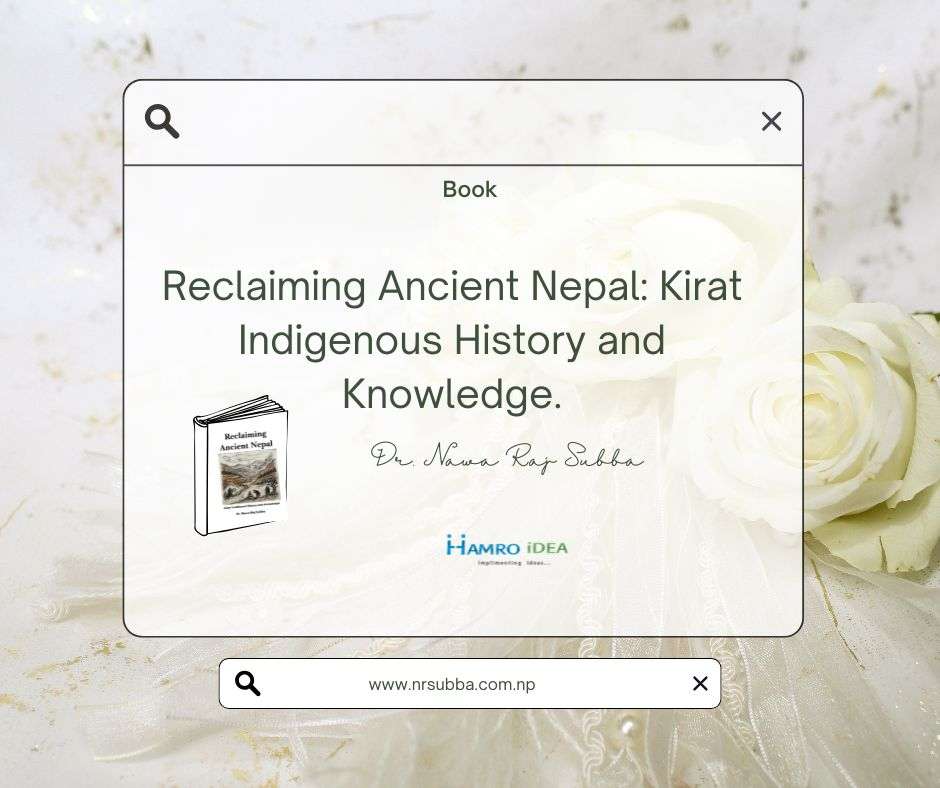
Reclaiming Ancient Nepal
Kirat Indigenous History and Knowledge
Dr. Nawa Raj Subba
Whose real history is the Himalayas?
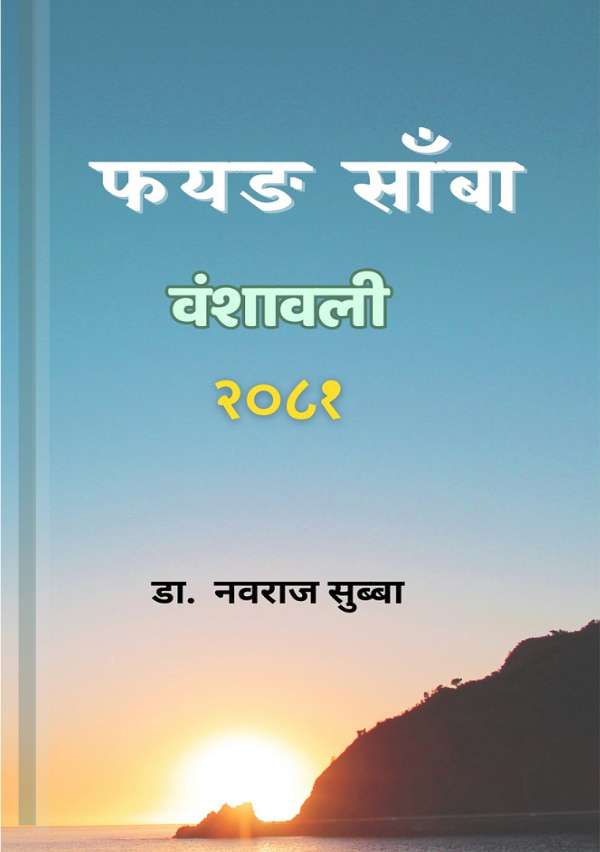
For centuries, Nepal’s ancient history has been interpreted solely from an external perspective. As a result, the original Kirat-Bon civilizations here have always been overlooked. This book, “Reviving Ancient Nepal,” challenges that established belief.
This book is prepared from the sacred verses of Mundhum to modern DNA testing. It brings together ancient oral traditions and modern science. The fact that the Kirati lineage is connected to the Indus Valley and East Asia is presented here.
What is in this book?
The battle of knowledge: Why was tribal history called only ‘tale’? How to re-establish it?
Scientific basis: An analysis of the archaeology of eastern Nepal and the hereditary history of the Kirati.
Philosophy and health: How can Mundhum become the basis of mental and social health?
The search for identity: The development of Kirati identity and global tribal consciousness.
Author’s Note
Topic: Reclaiming Ancient Nepal: Indigenous History and Ritual Knowledge
Authorial Positionality and Background:
I am Nawa Raj Subba, who belongs to the Kirat community and is a native of Taplejung. I grew up in the eastern hills in my childhood and secondary education. My entire professional life has been spent in the former Eastern Development Region and the current Koshi Province. Thanks to this reason, I am well acquainted with the geographical, cultural and historical background of this region. This is a closeness that has afforded me a chance to study and examine the Kirat civilization inside out.
The Indigenous Rights and Ethics:
The information in this study is the intellection of the Kirat community as a whole. When recording it, I have largely depended on the advice and the involvement of the ancestors and the elders of the community. This piece of work is a moral attempt to safeguard and pass on Indigenous knowledge.
Researcher’s Perspective:
Being a Kirat researcher, I have an inherent and emotional attachment to this traditional knowledge and practice. It is not just an academic exercise. It can also be described as a show of accountability to my people and my desire to preserve the marginalized Indigenous knowledge.
Objectives:
The main goal of the study is to bring about the forgotten history and the rich information of the Kirat people in a contemporary academic context. It seeks to establish an intellectual connection between the ancient practices of the Indigenous people and the modern scientific views.
Community Validation:
It is not just a set of personal opinions. Community experts, elders, and Mundhum scholars, among other stakeholders, have thoroughly examined it. The feedback and suggestions gained in the social media and face-to-face conversations were included, and the work has been perfected as a collective voice. Consequently, the research is a document that is approved and approved by the community.